AV & IT in the Enterprise – Post 6 of 6
Every office has them. The digital signage screen in the lobby showing an event from three months ago. The wayfinding kiosk on the fourth floor pointing to a team that moved to a different building in the spring. The space booking panel outside a room that was converted to a storage cupboard sometime last year. The background music system in the canteen that nobody has credentials for and everyone has learned to ignore.
Nobody installed these things carelessly. Each one arrived with a business case, a budget, and a go-live date. Each one was somebody’s good idea. And each one, at some point after the installation team left, became unclaimed baggage. Sitting in the corner of the org chart. Owned by nobody. Maintained by whoever happens to notice when something is broken.
The problem does not stay contained. It compounds. Each site configured differently. Each platform procured in isolation develops its own architecture pattern, its own support dependency, its own licensing arrangement. What should be a single line item becomes a sprawl. A digital signage platform licensed in pockets across a global estate, each business unit or regional team procuring their own instance, can cost five or six times more than a single centrally governed agreement. Nobody made a decision to overspend. The overspend is the residue of nobody making a decision at all.
Hardware follows the same logic. When there is no standard, procurement defaults to whatever was available, whatever the integrator recommended, whatever was cheapest at the time. The result is an estate of mismatched devices, each with its own firmware lifecycle, each with its own management interface, each expanding the attack surface that a security team has to manage. Standardised hardware models do not just make maintenance easier. They reduce the number of variables an attacker can exploit. The security posture of the building is, in part, a function of whether anybody ever decided what the building should run on.
This is not a new problem. It is the same problem that has run through this entire series, applied to every connected surface in the building that is not a meeting room.
The Tactical Project Problem
The meeting room estate, for all its challenges, at least gets attention. There is a procurement cycle. There is an integrator. There is a project. There is usually someone from IT involved, however late they arrive.
The rest of the building’s technology does not always get that much. Digital signage arrives because a facilities manager saw it at an exhibition and thought it would look good in the lobby. Wayfinding gets specified by the fit-out architect who included it in the furniture schedule. Space booking panels are procured through a workplace technology vendor who nobody from IT was involved with. Background music and media services are handled by whoever managed the last office refurbishment and have not been touched since.
Each one is a tactical project. A point solution to a specific problem, procured in isolation, delivered in isolation, and left in isolation. No standard. No support model. No connection to the wider estate. No owner.
Five years later the building is full of systems running on end-of-life hardware, with admin credentials that exist only in the memory of an engineer who left the company in 2021, displaying content that nobody has updated since the last rebrand, and generating data that nobody is reading.
The Convergence Nobody Planned For
For a long time these systems could be ignored in isolation because they operated in isolation. The signage was just screens. The wayfinding was just a kiosk. The space booking was just a panel. They did not talk to each other and they did not talk to anything else.
That is no longer true.
Space booking systems now integrate with Microsoft 365 calendar infrastructure. Wayfinding pulls from the same workspace management platforms that inform desk allocation. Digital signage is fed by content pipelines that connect to intranet, communications, and operational systems. Occupancy sensors feed utilisation data into analytics platforms that inform property strategy. Third-party SIP integrations even bring physical access into the platform, with intercom and door entry systems at reception routing visitor calls through Teams clients and answering from anywhere in the building.
And that is before you consider the cyber security and networking implications. These systems sit on the network. If nobody has designed for segmentation, access control, and security architecture across the estate, every new integration expands the attack surface.
The tactical projects that were procured in isolation are now quietly connected. And because nobody governs the connections, nobody is managing them. When the space booking system changes its API, the wayfinding breaks. When the signage platform updates its content schema, the feed from the intranet stops working. When the occupancy sensor firmware falls behind, the utilisation data becomes unreliable. Each system was someone’s problem. The connections between them are nobody’s problem.
The platform was always going to converge. The organisations that built their estates through tactical projects rather than portfolio governance are the ones now finding out what that costs.
The Signage Estate You Are Not Using
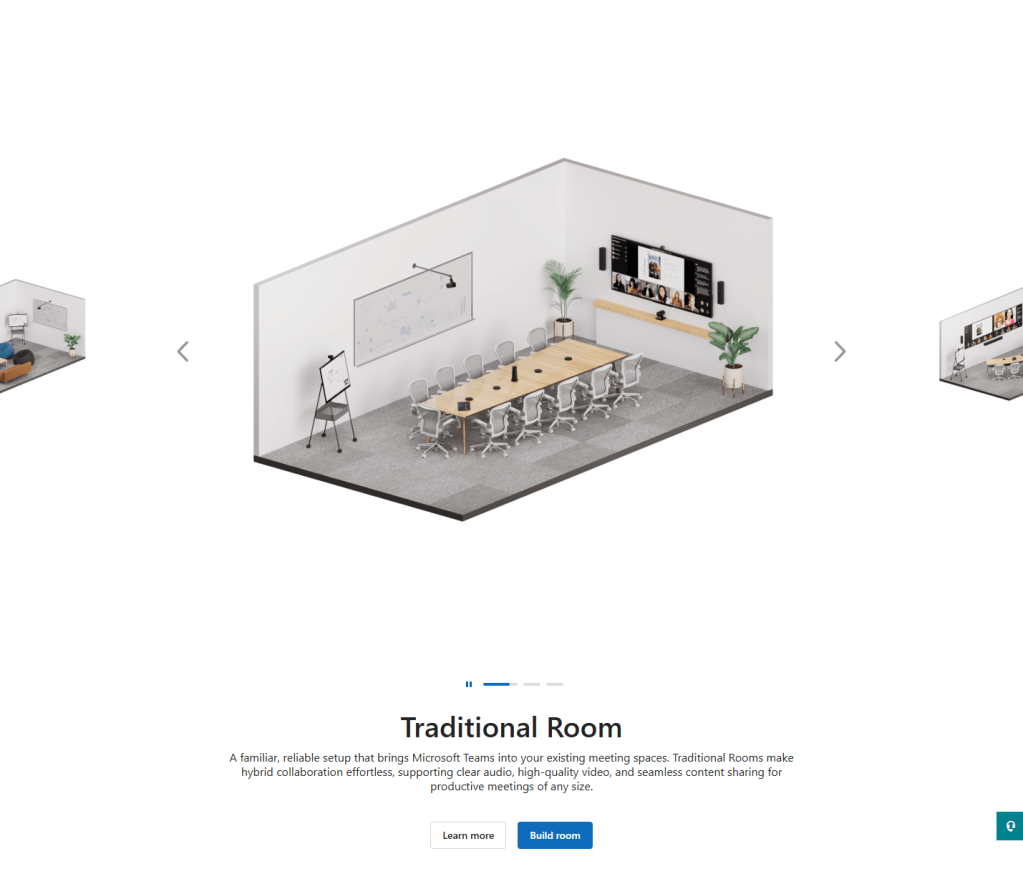
The meeting room display estate is one of the largest digital signage footprints in the building. Dozens, sometimes hundreds, of high-quality screens distributed across every floor. Between meetings those screens are blank. Or showing a screensaver. Or displaying a room name and a booking panel that nobody is reading.
The communications team does not know they can use them. IT does not think of the room estate as a communications channel. Nobody has connected the digital signage strategy to the meeting room estate because those two things were procured separately, governed separately, and have never sat in the same portfolio conversation.
The technology to close that gap already exists. Teams Rooms Pro Management supports digital signage natively on room displays when the room is not in a meeting, streaming content from third-party platforms like Appspace and XOGO, or directly from a web URL, configured centrally through the Pro Management portal. The room estate can show corporate news, operational updates, safety messaging, and culture content between meetings with no additional hardware investment. It is a capability sitting idle in most organisations because nobody with a communications brief has ever been told it is available, and nobody with an AV brief has ever thought to tell them.
The screens are already there, distributed across every floor, in the spaces where employees spend most of their working day. The capability is already there. What is missing is the person who sits at the intersection of the room estate and the communications brief and sees it.
Your Building Just Got an AI Upgrade
Over the last few years, and largely without organisations noticing, the building became part of the M365 platform.
Microsoft Places now reads occupancy data from calendars, booking systems and room sensors to understand how space is actually being used. That data feeds into something more consequential than a utilisation report. Copilot within Places can tell employees which days are worth coming into the office based on who else will be there. It can recommend the right room for a meeting based on how many people are attending in person versus remotely, and what technology is available in the space. When a room becomes unavailable, it rebooks automatically, handling conflicts across recurring meeting series without anyone picking up the phone or sending an email. The building is no longer just a place people come to work. It is beginning to actively help them work better.
Space management metrics, utilisation data, and room analytics live within Teams Rooms Pro Management and Places, feeding recommendations with real financial consequence about how much space an organisation needs, which floors to consolidate, and where investment should go next.
The governance gap that started with a meeting room that did not work on Monday morning has just become the foundation on which the AI-powered workplace strategy is being built.
If the data is ungoverned, the AI is ungoverned. If the systems are orphaned, the intelligence is blind. If the signage estate was never properly maintained, the content delivery layer of the intelligent workplace does not work. If the occupancy sensors were installed as a tactical project and never validated, the utilisation data feeding the property strategy is unreliable. And the organisation making million pound decisions about how much office space it needs, based on data from infrastructure nobody governed, is not making an informed decision. It is making an expensive guess with a confident dashboard in front of it.
The stakes of the governance gap have changed. They are no longer measured in failed meetings. They are measured in failed building strategies.
The Domain the Building Needs
This series began with a helpdesk ticket.
A room that did not work. A gap between the people who procured the technology and the people who had to support it. A domain that sat between IT, Facilities, and the integrator and was claimed by none of them.
Post 5 ended with a conclusion. The reason the governance gap remains unsolved in most organisations is not that nobody cares. It is that the discipline that would close it is unnamed, ungoverned, and unrecognised. This post has shown that the same gap extends far beyond the meeting room. The signage. The wayfinding. The space booking. The visitor management. The occupancy sensors. The room display estate that nobody is using for communications. The data flowing into an AI platform that is beginning to make consequential decisions about property and space.
All of it ungoverned. All of it unclaimed. And all of it falling under the same unnamed discipline.
That discipline is Workspace Architecture. It exists in the work of the people who have spent their careers at the intersection of technology, space, and human experience. Who understand that a standard is not a product list. That an archetype is not a room design. That a support model is not a helpdesk contract. That the building is not a collection of systems but a single connected estate that serves a single purpose.
It does not have a formal seat at the table yet. It does not have a universally recognised title, a professional body, or a certification framework. The work gets done in spite of that gap, not because it has been closed.
But as the building becomes part of the platform, as AI begins to consume the data the estate produces, and as the cost of ungoverned infrastructure rises from a bad meeting to a bad property decision, the case for naming the domain and giving it accountability becomes harder to ignore.
The baggage has been sitting unclaimed for long enough.
It is time to put a name on it.